Copart sold prices: see what any model really sells for
Where to find Copart and IAAI sold prices, why the current bid misleads, and how to turn recent sales into a price range for the model you want.
Copart and IAAI sold prices are the final results of finished auctions: what each car actually went for, not the bid you see while the lot is still open. To see them for a whole model, use a report that gathers recent finished sales and plots them against mileage. Then you know the normal price range before you bid on a single car.
Why the current bid on a lot page misleads
An open lot shows the current bid and sometimes a Buy Now price. Neither is a sale. Much of the bidding happens in the live auction, so the bid you see days before often ends up far below the final price. Buy Now is the seller's asking price, which may or may not be met.
Where to find Copart and IAAI sold prices
The auction sites are built around cars for sale now. Once an auction ends, the result is hard to find there.
Archive sites keep finished lots with their sale prices, and you can look up a VIN to see one car's past. That's useful for checking a single car. To learn what a model sells for, though, you'd open sale after sale and work out the pattern yourself.
The auction price history report on CarAuctionData.com does that reading for you. Pick a make, model and years, and it collects the finished sales from both Copart and IAAI into one chart.
What a report shows: an example
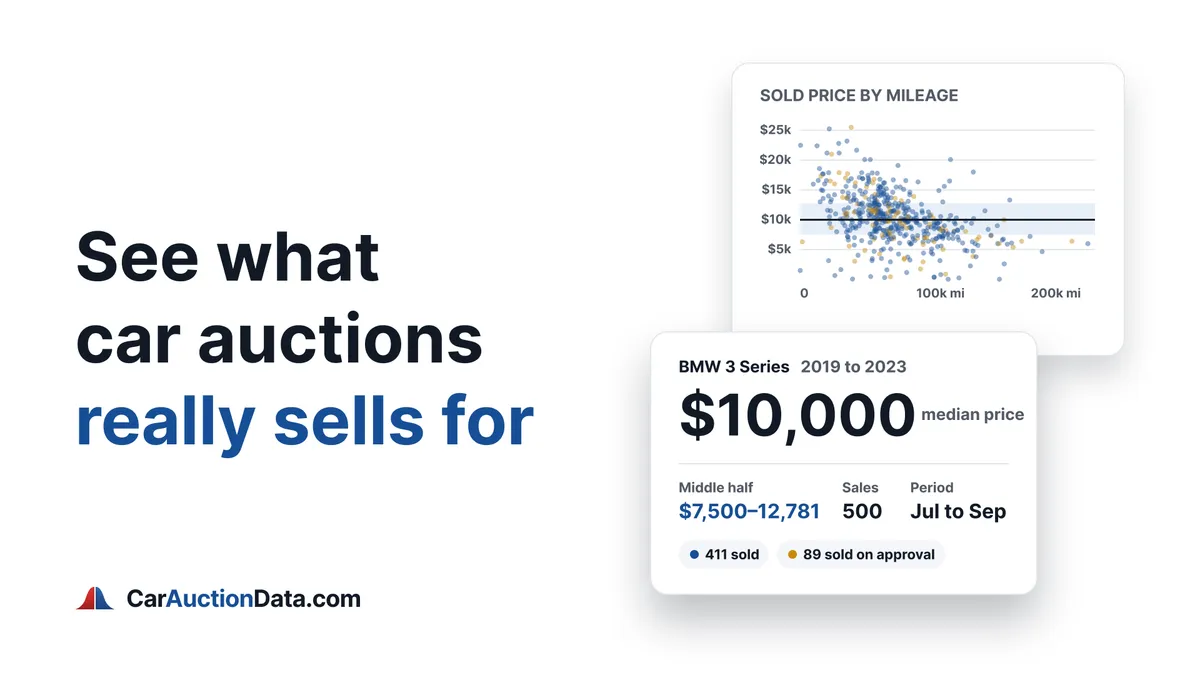
Our example report covers the BMW 3 Series, model years 2019 to 2023, on US salvage auctions. It was run on 25 September 2026.
- 500 sales, from 20 July to 25 September 2026. The 3 Series sells often, so the report kept the newest 500: recent sales are the best guide to today's price.
- Median price: $10,000. Half the cars sold between $7,500 and $12,781.
- 89 of the 500 sold on approval, meaning the seller accepted the final bid after the auction ended. Those are real prices, so they count, and the report also shows them separately.
What the report works out for you
- Clean data. Duplicates and auctions that didn't sell are left out, and so are sales with no recorded price or impossible mileage, like a car listed at a million miles. Real results, heavily damaged cars included, stay in.
- Price against mileage. Each sale is a dot on the chart, with a trend line showing how the price drops as the miles go up.
- Three bands around the trend line: below market, market price and above market. A sale's band tells you whether it went cheap or dear for its mileage.
- Filters for model year, condition (runs and drives, engine starts) and mileage, so you can narrow the chart to cars like the one you want.
- Every sale is open. Open any sale to see the car and look up its VIN.
How to use sold prices before you bid
- Run a report for the model and years you're after.
- Filter it down to cars close to yours: same condition, similar mileage.
- Find your car's mileage on the trend line. That's roughly what the market pays for it.
- When you find a specific lot, check it with the auction price calculator, which compares it with the most similar sales and adds up the total cost.
Common questions
Where can I see Copart sold prices?
Copart's site is built around cars for sale now. Archive sites show past lots one VIN at a time. A price history report on CarAuctionData.com puts the last six months of finished Copart and IAAI sales for a model on one chart.
How far back do the sold prices go?
The last six months, up to 500 sales. If a model sold more often than that, the report uses the newest 500.
What does "sold on approval" mean?
The seller accepted the final bid after the auction ended. It's a real sale price, so the report counts it and shows it apart from cars sold outright.
Does a sold price include auction fees?
No. It's the winning bid. Buyer fees, towing and shipping come on top; the price calculator adds them up for you.
How many reports can I run?
A free account gets 2 reports a day, with no card needed. Dealer accounts use credits instead of daily limits. Every report is saved to your account.