How to buy a car from Copart or IAAI: first-time guide
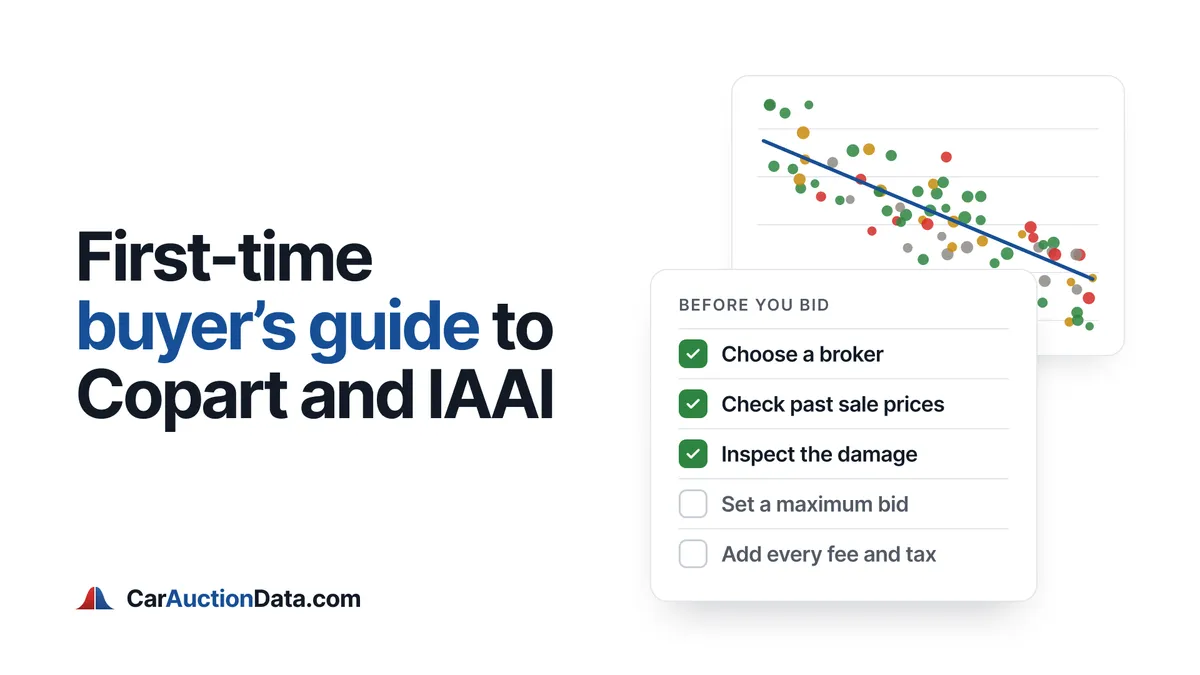
First time buying at Copart or IAAI? How to bid without a dealer licence, pick a broker, spot hidden damage and count every fee before you bid.
To buy a car from Copart or IAAI, you go through a broker: a licensed company that bids for you on its own auction account, pays the auction and arranges towing and export. Before you bid, check what similar cars sold for, look closely at the photos for damage that isn't obvious, and add buyer fees, towing, shipping and taxes to your bid.
Where US salvage cars are sold
Copart and IAAI (Insurance Auto Auctions) are the two big US salvage auctions. They sell damaged, stolen-recovered and insurance write-off cars online. Each lot has photos, a damage description, the mileage, the title type and the car's location. You bid online, either live or with a pre-bid that the system raises for you up to your limit.
A bid is binding. If you win, you've agreed to buy the car at that price, plus fees.
Do you need a dealer licence to bid on Copart?
For many cars, yes. Copart lets anyone register, but a lot of its cars can only be bid on with a dealer or business licence. Copart marks the cars any registered buyer can bid on as "No License Required". IAAI also restricts many vehicles to licensed buyers.
That's why almost everyone buys through a broker, and nearly every buyer outside the US does. The broker places the bid on its own account for you, for a fee. Even for a car you could bid on yourself, you'd still have to pay the auction from abroad, book the towing and handle the export paperwork. A broker does all of that in one place.
How to choose a broker
The broker holds your money and places bids in your name, so pick one carefully. We don't recommend a specific broker. Check these things before you sign up:
- Registered with the auction. Copart keeps a list of its registered brokers on its own site. Start there.
- Reviews from real buyers. Read reviews outside the broker's own site: Google reviews, Trustpilot, and buyer forums and Facebook groups for your country. Look at how they handled problems, not only the happy stories.
- Every fee in writing: the broker fee, payment and wire fees, and what happens to your deposit if you lose or change your mind.
- What they handle after the win: towing to the port, export paperwork, shipping and customs. A broker who does all of it saves you from coordinating four companies.
- How fast they answer. Auctions run on deadlines. Ask a question before you sign up and see how long the reply takes.
Set your price range with past sales
Before you look at a single lot, find out what your model actually sells for. The current bid on a lot page tells you very little: cars often finish far above it, and the Buy Now price is the seller's asking price, not a sale.
The auction price history report on CarAuctionData.com pulls the last six months of finished sales for a make, model and years, up to the newest 500. Each sale is plotted against its mileage, with a trend line and three bands around it: below market, market price and above market. Filter by model year, condition and mileage to see the cars closest to the one you want.
Let matching cars come to you
Searching two auction sites every day gets old fast. With auction alerts you choose a make, model and years once, and every matching car open for bidding on Copart and IAAI lands on one page with photos. Each day, at the hour you pick, new matches come to you by email, Telegram or both. Star a car and you get a reminder 10 minutes before its auction.
Work out what to bid
When a car looks right, paste its lot link, lot number or VIN into the auction price calculator. It compares the car with recent sales of the same model, close in year and mileage, with similar damage and run condition, and lists every one of those sales so you can check them.
You get an estimate and a price guide in three bands: below market, market price and above market. In our tests on past sales, about half of cars sold inside the likely range and about 8 in 10 inside the wide range. Use the market price band to set a maximum bid, and stick to it when the live auction speeds up.
The calculator also warns you if the car already sold at auction and is back, or ran before without selling. More on why that matters below.
What to check before you bid on a salvage car
Photos and a one-line damage description leave a lot out. These are the things first-time buyers miss most often.
Did the airbags go off?
Deployed airbags mean a hard enough hit to fire them, and replacing them is expensive: the bags, the seat belt pretensioners, often the dashboard and the control module. Look for open airbag covers on the steering wheel and dashboard, curtain airbags hanging from the roof lining, and seat belts locked across the seat. A car with a small dent and deployed airbags can cost more to fix than one with a bigger dent and none.
Does it run and drive?
Copart and IAAI note each car's condition when it arrives at the yard. "Run and Drive" means it started and moved under its own power at that check. "Engine Starts" means it started but wasn't driven. "Stationary" means it didn't start. None of these is a promise about the car today: batteries die and damage gets worse in storage. Still, the condition changes the price a lot, which is why our reports let you filter by it and the calculator matches on it.
Has it been sold at auction before?
Some cars go round. A car sells, gets a cheap repair or none, and comes back under a new lot number. Others run week after week without reaching the seller's minimum. Either can be a sign of a problem the photos don't show. The auction price calculator checks the VIN's earlier runs on both auctions and shows each earlier sale and each unsold run with its date and price.
Is the damage in one area?
Damage confined to one corner, like a front bumper, headlight and fender, is usually easier to price and repair than damage spread around the car. Hits on two sides, a roof that's dented, or damage plus a flood note add up quickly.
Look at the panel gaps
The gaps between the doors, hood, fenders and trunk lid should be even on both sides of the car. Even gaps away from the damage are a good sign the body and frame are straight. A door gap that's wide at the top and tight at the bottom, or a hood that sits off-centre, can mean the frame has moved, and frame repairs are among the most expensive.
Damage the photos don't show
- Water: a line of dirt on the door panels, mud or silt under the seats or in the trunk, or fogged lights. A flood car can look clean in the photos.
- Keys: check whether the listing says the car has keys. A replacement key for a modern car is expensive.
- Title type: salvage, parts only, certificate of destruction. Some can't be registered for road use at all, in the US or in Europe.
- Hidden structure: the underside, the trunk floor and the pillars rarely appear in photos. A broker or a paid inspection can check them for you.
Add up every fee and tax before you bid
The winning bid is only part of the price. On top of it you pay:
- Auction fees: a buyer fee that grows with the price, plus gate, environmental, title and online bidding fees.
- The broker fee.
- Towing from the yard to a port or to you. Move quickly: the auction charges daily storage after a few free days.
- Shipping to Europe, if you're importing.
- Import duty and VAT in the country where the car clears customs. Since 1 July 2026, cars built in the US can import into the EU at 0% duty instead of 10%, if you can prove where the car was made.
- Registration taxes, repairs and inspection in your own country.
The auction price calculator adds the auction fees, towing to a US port, shipping to one of five European ports, import duty and VAT, in US dollars and euros. Type in your own bid and the total updates. Broker fees, port charges, registration and repairs depend on who you use and where you live, so add those yourself.
The checklist
- Pick a broker registered with the auction; check reviews and get every fee in writing.
- Run a price history report for the model you want.
- Set an alert and let matching cars come to you.
- Before you bid, check airbags, run condition, earlier sales, where the damage is, panel gaps and title type.
- Paste the car into the price calculator, set your maximum bid and check the total cost.
Common questions
Can I buy from Copart without a dealer licence?
Yes, through a broker registered with Copart, who bids for you on their own account. That's how almost everyone buys. Copart also lets registered buyers bid on cars marked "No License Required" without a broker.
Does "Run and Drive" mean the car is safe to drive?
No. It means the car started and moved under its own power when the auction checked it in. It says nothing about brakes, steering or the frame, and the car may not start by the time it's picked up.
How do I know if a car was sold at auction before?
Search the VIN. The auction price calculator on CarAuctionData.com checks the VIN's earlier runs on Copart and IAAI and lists each earlier sale and each run that didn't sell, with its date and price.
What fees do I pay on top of my bid?
Auction buyer fees, gate and environmental fees, the broker fee, towing, storage if you're slow to collect, shipping, and import duty and VAT if you're importing.
Can I buy a car from Copart if I live in Europe?
Yes, through a broker who bids, pays the auction and arranges towing and export. Add shipping, import duty and VAT to the price before you bid.
Create your account
Check what your car is worth before you bid. Create a free account and run your first price history report.