Which US auction cars now import to the EU at 0% duty
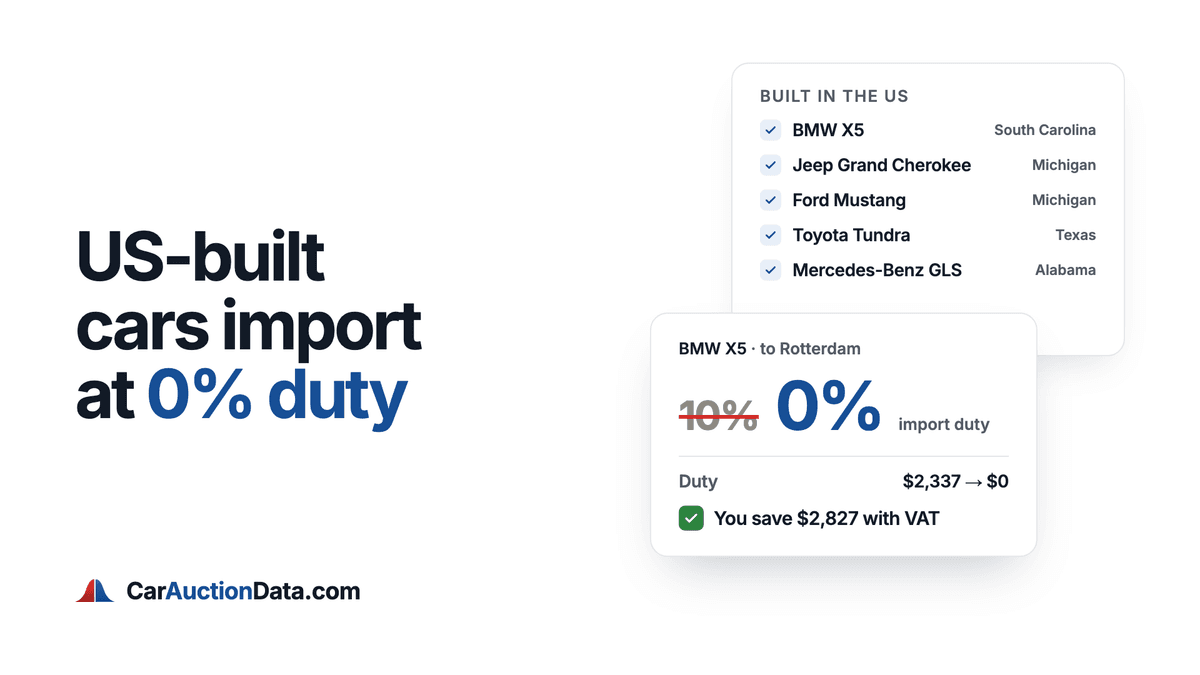
Since July 2026, cars built in the US pay 0% EU import duty instead of 10%. Which popular auction models qualify, how to prove it, and what you save.
Since 1 July 2026, passenger cars built in the United States can be imported into the EU at 0% duty instead of the usual 10%. What counts is where the car was built, not the brand, so a BMW X5 from South Carolina qualifies and a Chrysler Pacifica from Canada doesn't. Below is a list of popular auction models built in the US.
What changed
The EU cut its duty on US-made goods, cars included, under Regulation (EU) 2026/1455. For cars:
- The rate: 0% instead of 10% for passenger cars made in the US.
- The dates: from 1 July 2026 to 31 December 2029.
- What counts: where the car was built. A US brand built in Canada or Mexico pays 10%; a European or Japanese brand built in the US pays 0%.
- Who decides: customs, when the car is cleared. You have to show the car was made in the US. If customs isn't satisfied, it charges the 10%.
- It can change: the European Commission can suspend the cut if the US doesn't keep to the trade deal behind it.
VAT doesn't change. You still pay it in the country where the car clears customs.
Popular auction models built in the US
Every car of these models sold new in the US was built in the US, so the ones you find at a US auction were made there. Where production moved to the US partway through, the first model year built there is in brackets.
European brands
- BMW X3 (2011 on), X4 (2015 on), X5, X6, X7, XM: Spartanburg, South Carolina
- Mercedes-Benz GLS (and the older GL), EQE SUV, EQS SUV: Vance, Alabama
- Volkswagen Atlas, Atlas Cross Sport: Chattanooga, Tennessee
- Volvo EX90: Ridgeville, South Carolina
American brands
- Tesla Model S, Model X: Fremont, California
- Tesla Cybertruck: Austin, Texas
- Ford Mustang (not the Mustang Mach-E): Flat Rock, Michigan
- Ford F-150, Explorer, Escape, Expedition: Michigan, Illinois, Missouri and Kentucky
- Ford Bronco (not the Bronco Sport), Ranger: Wayne, Michigan
- Lincoln Aviator, Corsair, Navigator: Chicago, Illinois and Louisville, Kentucky
- Chevrolet Corvette: Bowling Green, Kentucky
- Chevrolet Camaro (2016 to 2024): Lansing, Michigan
- Chevrolet Tahoe, Suburban, GMC Yukon, Cadillac Escalade (2015 on): Arlington, Texas
- Chevrolet Traverse: Lansing, Michigan
- Cadillac CT5, XT5, XT6, Lyriq: Michigan and Tennessee
- Jeep Grand Cherokee, Wrangler, Gladiator: Detroit, Michigan and Toledo, Ohio
- Jeep Wagoneer, Grand Wagoneer (not the Wagoneer S): Warren, Michigan
- Dodge Durango: Detroit, Michigan
- Rivian R1T, R1S: Normal, Illinois
Japanese, Korean and other brands
- Toyota Tundra, Sequoia: San Antonio, Texas
- Lexus TX: Princeton, Indiana
- Honda Pilot (2009 on), Passport, Odyssey (2005 on), Ridgeline (2009 on): Lincoln, Alabama
- Acura MDX (2014 on), RDX, Integra (2023 on): Ohio
- Kia Telluride: West Point, Georgia
- Infiniti QX60: Smyrna, Tennessee
- Mazda CX-50: Huntsville, Alabama
Some models are built in the US and in other countries, including the Toyota Camry and RAV4, Honda Accord and CR-V, Tesla Model 3 and Model Y, and Mercedes-Benz GLE. They aren't on the list because the model alone doesn't tell you where a particular car was made.
Popular at auction but not built in the US (10% duty): BMW 3 Series and 5 Series, Audi, Porsche, Land Rover, Chrysler Pacifica, and the Dodge Charger and Challenger up to 2023, which were built in Canada.
How to prove the car was made in the US
There's no single required document. The regulation uses the EU's normal origin rules, and the customs office that clears the car decides what's enough. Italian customs, the first to publish guidance, said in July 2026 that a certificate of origin is recommended but not mandatory.
A certificate of origin is issued when a car is new, and a used car bought at auction usually doesn't come with one. Before you ship, ask your broker or customs agent what the port you're shipping to accepts.
What 0% saves you
Take a BMW X5 won on Copart for $20,000 and shipped to Rotterdam. With Copart's buyer fees, $500 for towing to Savannah, and shipping, the car's value at customs is $23,370.
- At 10% duty: $2,337 duty and $5,398 Dutch VAT (21%), so the car costs $31,105 landed in Rotterdam.
- At 0% duty: no duty and $4,908 VAT, so it costs $28,278.
You save $2,827. That's more than the duty itself, because VAT is charged on the duty too.
The auction price calculator adds up buyer fees, towing, shipping, duty and VAT for any lot, for five European ports. It shows duty at the standard 10%. If your car is on the list above, take the duty line off the total.
Common questions
Is the BMW X5 duty-free in the EU?
Yes, if you can show customs it was made in the US. X5s sold in the US are built in Spartanburg, South Carolina.
Do Canadian- or Mexican-built cars get 0%?
Not under this rule. It covers cars made in the US. A car built in Canada or Mexico pays the usual 10%, whatever the brand.
How long does the 0% duty last?
From 1 July 2026 to 31 December 2029, unless the European Commission suspends it sooner.
Do I still pay VAT?
Yes. VAT is charged in the country where the car clears customs, on the car's value plus shipping and any duty. With 0% duty, the VAT is a little lower too.
How do I know if a car was built in the US?
Check the list above. If the model, and the year where one is given, is on it, the car was built in the US.